
Originally published on LinkedIn for Stranger Collective.
Forest ecologist Sam Manning on discovering the ‘flowscape’, how it redefines nature and could help revive natural landscapes at scale
The landscapes of the natural world bleed into each other. Woodlands run to the river edge. Marram grass gives way to sand, gives way to sea. The wild inhabitants of these landscapes don’t exist in isolation either.

Yet, this is often how we see nature and how we talk about it.
When Sam Manning studied ecology around 2010 he learnt about a world made up of isolated single habitats: “I was traditionally educated in ecology, which very much had a focus on single species, single habitats – born out of this period of time in the 1960s and 1970s where conservationists were often individual rich people with a single focus and really only the ability to do conservation on small amounts of land.”
But Sam was learning traditional ecology at a time when new ideas were taking hold, a nascent rewilding movement was emerging and a new, more imaginative, style of ecology was “telling us that we had to think at landscape scale; we had to think about landscapes and species that are gone now but should be back.”
As the old ecology interfaced with the new, conservation and rewilding were failing to deliver. “There was an immense amount of cognitive dissonance and frustration, and so that led me to begin to think that we’re not doing this right, there has to be a bigger picture, there has to be another step.”
We don’t talk about how virtually every square metre of land in the UK has been drained. The physical landscape is not able to facilitate that movement of water anymore
Escape abstraction. Embrace chaos
This preoccupation pulled Sam down a path to escape the abstract hold over how we think about the world around us.
“Our abstraction of nature is killing it because we’re trying to manage it in a way that doesn’t align with how it works,” he says.
The epiphany was a new understanding about how ecosystems – from woodlands to peatlands to rock pools – function and “how systems flow together.”
“The huge problem we have in both rewilding and conservation is that we consider land parcels and sea parcels as being static and unchanging,” says Sam.
“Seeing nature through its functions relates to system science. Systems are highly complex; they’re super changeable, chaotic, but they find stability in the chaos. It’s about the interaction between things, not what the actual things are.”
Enter the flowscape
This new way of seeing nature led to a new word: the flowscape. It emerged from a scoping review of evidence about the relationship between ocean and forest habitats by Dr Benjamin Phillips.
A short, month-long process uncovered a total of 276 studies that had found evidence of the interrelationships between forest and oceans, from how ocean climate has affected tree growth to the impact of forests on salmon numbers. Many of the studies were carried out in Canada and Japan and related to temperate rainforests – an ecosystem these countries share with parts of the UK.
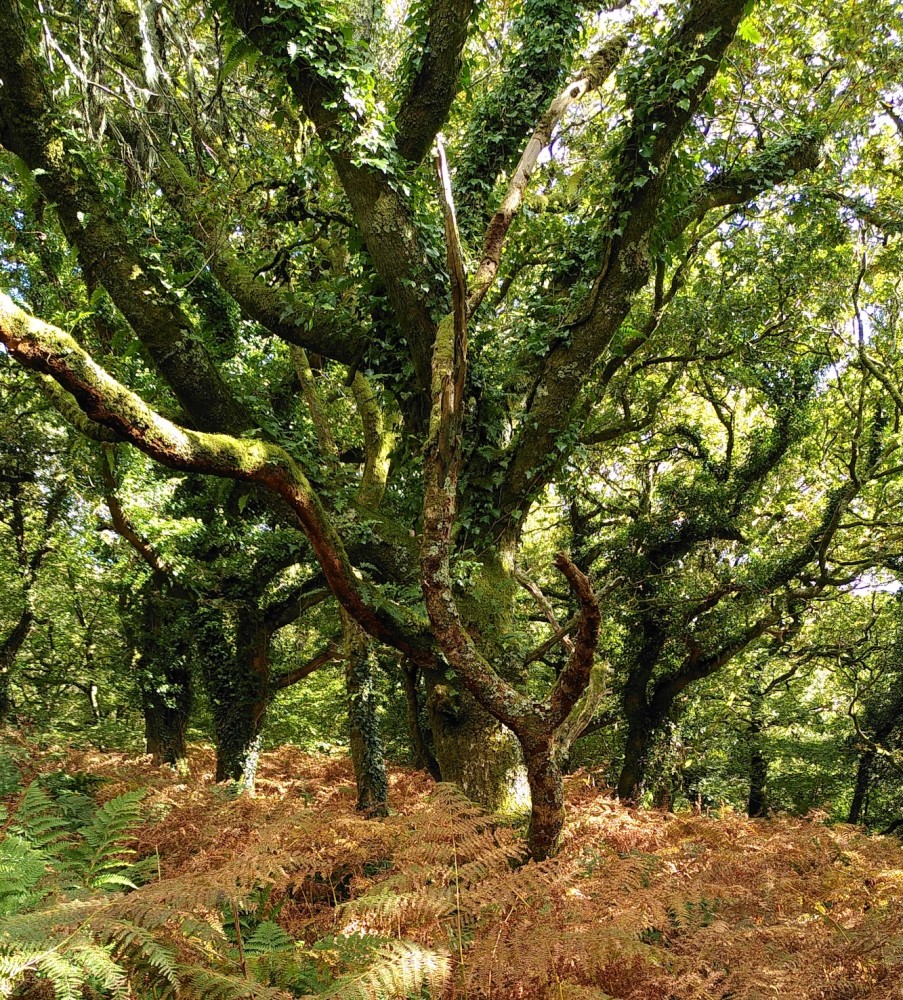
The landscape relationships described by the flowscape go further than the connections of a water cycle or carbon cycle. “We’re linking the chemical cycles to the biological system, which is not something that’s really done. We don’t talk about how those are interacting with facilitating life. We’re also fundamentally saying that those systems are broken.
“So with the water cycle, people will say, you know, the water goes from the top to the bottom of the system, and that’s it. We don’t talk about how virtually every square metre of land in the UK has been drained. The physical landscape is not able to facilitate that movement of water anymore.”
For Sam, if we don’t put these cycles at the centre of how we care for our landscapes, we won’t be able to restore them.
Where it rains
Temperate rainforests – biodiverse woodlands in colder climates with high rainfall – are where the flowscape can be seen in technicolour – because the “cycles of energy, the flows of those systems, are much higher because you’ve got far more rainfall, and water is basically what flows systems together.”
If water is the great connector in the flowscape, trees are the great creator of habitats where life can thrive. Sam is part of the team behind Plant One’s No Trees, No Seas campaign sharing the science that shows the crucial links between oceans and forests.
We haven’t had an intersectional environmental movement.
As restoring woodlands has the potential to restore fish stocks, revive sea grass and kelp and reverse plankton decline, the campaign is pushing one big idea: “In order to save the seas, we need more trees.”
But don’t we already know trees are good for us? Not necessarily.
“If you step back a second and look, we have approximately 13% forest cover in the UK. In Devon and Cornwall, we’ve got about 10%. In Europe, that’s about 38% on average, and in some places, like Japan, as high as 70%,” says Sam.
“We know that once we would have been close to 80% forest cover, so we’re one of the most tree denuded countries on Earth and we’re only planting 50% of the government’s planting targets, which are already meagre. We don’t actually fundamentally value trees. And we’re not prioritising them at all.”

Where it intersects
Farmland has more value than woodland. Fishing has more value than fish. These truths have a hold on, and sustain, society. Principles like these sustain vested interests, and are often a barrier to major environmental change or inhibit financial backing. When interests intersect, change can really happen at scale.
The flowscape is intersectional. This is science that shows how landscapes intersect and how interests intersect too.
“An interesting proxy for this that’s already had huge amounts of success is the intersectional social justice movement where disparate groups realised the commonalities they had and the power that brought,” says Sam.”
“We haven’t had an intersectional environmental movement.”
Key findings from the research Sam commissioned include studies that show how forest cover increases fish stocks and “twenty-four studies” demonstrating “how forests can improve water quality”.
These are evidenced effects where interests intersect, where fishermen watch the weather and the forests, and water-quality worriers become treehuggers.
Looking at the source of the flowscape from our advantageous perspective in one of the world’s temperate rainforest zones, we’re wondering just how far it could reach.
Impact interest
Stranger Collective selected Plant One as their environmental impact partner in 2024, making a donation to support tree planting and stewardship based on 2024 emissions levels, and helped plant a new area of temperate rainforest during a team volunteer day at Clowance Farm, Cornwall, in early 2025.
Sam is currently working with Dr Benjamin Phillips on new research into UK data on these flowscape interrelationships, and you can find out more about the No Seas No Trees campaign at https://notreesnoseas.com/.
